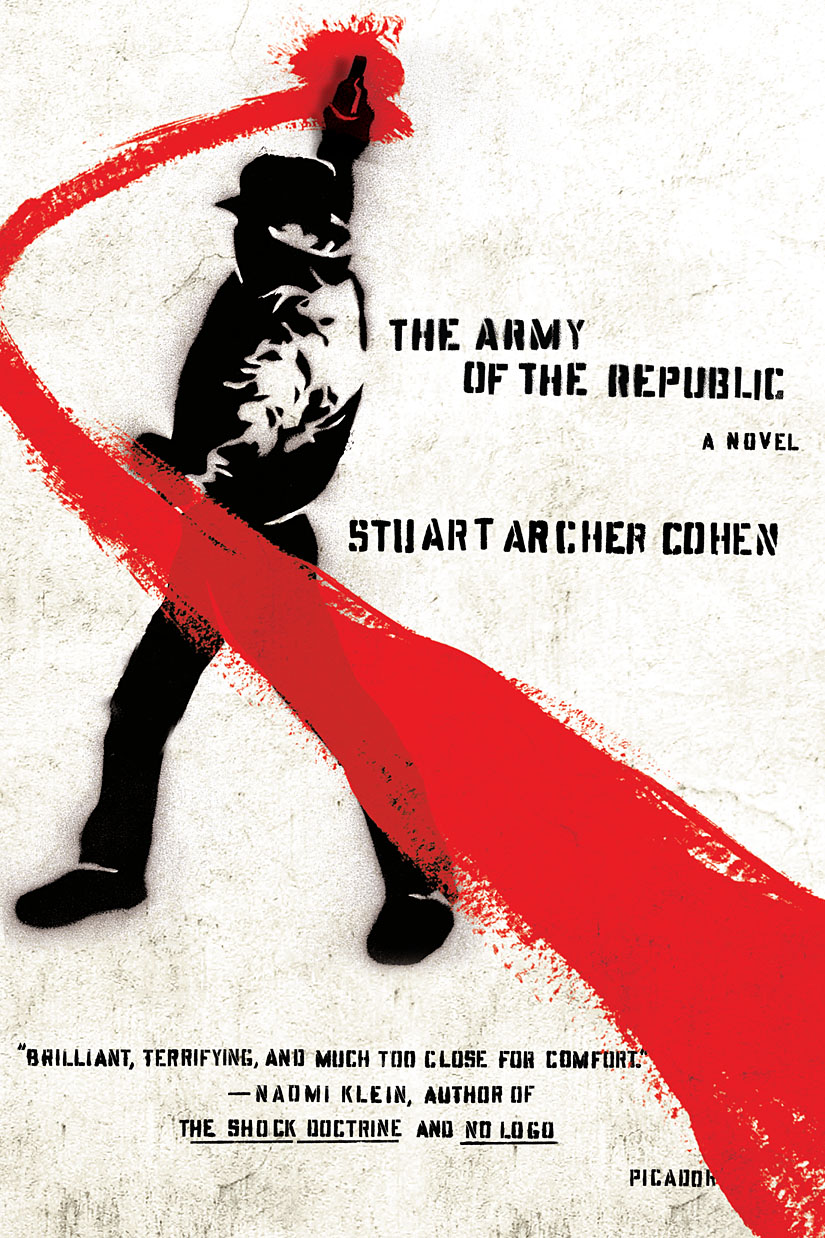
The Army of the Republic
St. Martin’s Press / Picador, 2008
432 pages · Optioned for film by Oliver Stone
Buy this book
In an America stretched by crisis to the breaking point, billionaire entrepreneur and government insider James Sands is riding high. Over the protests of civic groups and the increasing alienation of his wife, Anne, Sands is poised on the brink of an immensely risky and controversial deal that will give him control of all public water in the Pacific Northwest. But when his business partner is murdered by a radical group called The Army of the Republic, Sands finds himself losing control of his business and his life.
Meanwhile, in Seattle, a young guerrilla named Lando leads The Army of the Republic into a dangerous war of ideals. Charismatic and cunning, Lando is obsessed with the goal of saving the country from its corrupt ruling alliance by any means necessary. His reluctant ally is political organizer Emily Cortright, coordinator of a network of civil, religious, and labor groups.
Thrilling and unforgettable, The Army of the Republic is a brilliant, provocative novel about what it means to live in a democracy.
“Chilling vision of a not-too-distant future… Mr. Cohen writes with conviction.”
The New York Times
“Read it quick, while it’s still fiction.”
David Maine, author of The Preservationist
“This timely, well-written, and very dark novel is a winner.”
Library Journal
The Inside Story
The idea of revolution had been kicking around in my head and my journals ever since my first trip to Central and South America in 1984, a fact that wasn’t looked on very kindly by the Salvadoran military when they arrested me and translated my journals on my first eventful trip south. I remember that incident clearly, especially being blindfolded and interrogated for 8 hours at the San Salvador jail, and thinking, this guy with the black shoes (I could see a tiny slit of the floor through the bottom of the blindfold) seems nice, just a cop doing his job, but that one with the brown loafers, he’s bad news. He’s one of those death-squad guys. And that perception, correct or incorrect, of the mixture of perfectly decent people and rather evil people, thrown together by a bad situation, stayed with me.
When I saw the drift of the country after 2000, I felt more and more that my next book should take on the subject I’d been wanting to write about for nearly two decades. I jotted down an opening paragraph of AOR when I was still finishing 17 Stone Angels, and didn’t return to it for a couple of years. The rough draft was finished in early 2005.
The research was much more difficult than I’d anticipated. I accumulated a shelf full of interesting books: how to form a new identity, improvised explosives, surveillance and bodyguarding. Also many thick books in Spanish about Argentine urban guerrillas of the 1970s, which I rounded out with interviews in Buenos Aires. I talked to organizers of the 1999 WTO Protests, student activists, 1960s activists, CIA people and assorted others.
But the most important element of The Army of the Republic — the conflict between James Sands and his estranged son — came directly from my own life. My own 8-year-old son was going through a particularly defiant phase, and I couldn’t help but visualize how it might play out if I never learned to deal with it constructively. That became the seed of the relationship between James and Joshua Sands, which is ultimately what drives the book.